Familiar Risks, Shifting Dynamics…
The risks and uncertainties shaping the market remain largely unchanged from last quarter—ongoing conflict in the Middle East, persistent inflation, and the continued Artificial Intelligence (AI) investment tsunami. However, the dynamics surrounding these risks have shifted again. A stalemate continues between U.S. forces and Iran over control of the Strait of Hormuz while increased economic sanctions and sharply reduced oil exports have placed significant pressure on Iran’s economy. Encouragingly, oil flows through the Strait have recovered to nearly pre-war levels, although significant damage to regional refining infrastructure has created a supply crunch for refined petroleum products. As economic pressures mount, experts are concerned that Iran, or its proxies, will retaliate aggressively at other regional oil producers.
A shortage of refined petroleum products, especially diesel, is the latest source of inflationary pressure—a byproduct of the Middle East conflict that has had significant ripple effects throughout the U.S. economy. U.S. inflation continues to remain at unacceptably high levels, lasting far longer and higher than many initially expected. Further adding to the upward price pressures is the continued AI buildout which shows little sign of slowing. Helping further drive the economy, and price levels, are high-income consumers who continue to spend at a healthy clip. Together, these forces are keeping inflationary pressures elevated and complicating the Federal Reserve’s path moving forward.
With inflation proving stubborn, the Federal Reserve’s rate-setting committee raised its benchmark interest rate last month—the first increase since July 2023. Markets are currently pricing at least one additional interest rate increase before year-end. Many market participants expected newly appointed Fed Chair Kevin Warsh to bow to political pressure and refrain from raising rates. Instead, the September rate hike reinforced the Fed’s independence and its willingness to prioritize its mandate for price stability, i.e., lower levels of inflation, despite severe political pressure from the White House – a development that we were extremely encouraged to see.
One of the biggest forces working against the Federal Reserve is the unprecedented arms race among the world’s largest technology companies, each competing to establish a dominant position in the rapidly evolving AI landscape. These companies have devoted at least $850 billion this year towards their unrelenting effort to win the AI battle. In doing so, demand for labor, computing infrastructure, energy, and other related inputs has surged strongly as have its related costs. This spending surge is creating a wide range of effects across the economy, supporting growth and investment in some areas while adding to inflationary pressures and resource constraints in others.
The scale and persistence of the AI investment cycle is unprecedented in U.S. history. AI infrastructure investment is projected to be $10.3 trillion between 2025 and 2032, or equivalent to ~3.6% of U.S. GDP annually. Five of the major hyperscalers alone will account for nearly $4 trillion in spending by the end of 2029. One estimate is that for the buildout to pay for itself, AI revenue would need to be nearly 9% of GDP by the early 2030s—or nearly as much as the American consumer currently spends on food. If this current tech build out continues at its projected pace, to say that the future strength of the U.S. economy will be closely linked to AI’s success would be a considerable understatement.
Looking ahead, we do not expect the key risks facing the economy to change significantly. Instead, the range of potential outcomes surrounding these forces is likely to shift. Iran, for example, has endured significant economic pressure for years, suggesting that its current difficulties may not lead to the near-term resolution many stakeholders desire. At the same time, elevated input costs and a resilient American consumer could continue to put upward pressure on prices. Finally, AI capabilities and the continued buildout of the industry are likely to remain major economic forces with the pace and success of that investment increasingly influencing the broader economic outlook. Against this backdrop, Chair Warsh and the Federal Reserve will continue to face a difficult policy environment with the strong likelihood of further rate increases needed to rein in elevated inflationary pressures.
Volatility Has Entered the Credit Markets….
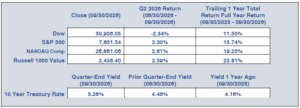
While equity markets have experienced their own share of volatility over the past quarter, fixed income markets have seen even greater turbulence in recent weeks. After the Federal Reserve decided to raise overnight interest rates in mid-September, the Treasury Department attempted to place downward pressure on longer-term yields by buying a modest amount, $6 billion, of long-dated Treasuries. However, bond investors ignored the Treasury Department’s signaling as they then pushed interest rates to 20-year highs with the bellwether 10-year U.S. Treasury yield briefly reaching 5.37% – its highest level in more than 20 years.
In the last 12 months, the 10-year’s yield has climbed more than 25% from less than a 4.20% yield last Fall. Helping drive rates higher has been the furious pace of new borrowings associated with the AI race – estimated to exceed $500 billion in new lending in 2026. With a number of the hyperscalers carrying credit ratings comparable to that of the U.S. government, competition for capital could keep Treasury yields elevated for a prolonged period, especially if action is not taken to tame the U.S. worsening deficit and debt situations.
This year, the U.S. federal deficit is estimated to have been ~6% of GDP, or an estimated $2.0 trillion shortfall for fiscal 2026. Of the world’s largest economies, only China and Brazil will have greater budget deficits than the U.S. with most other developed nations realizing spending shortfalls of less than 4%. With this current level of deficit spending/borrowing occurring during a strong economic expansion, we at Dumaine remain extremely concerned over the budgetary ramifications when the economy eventually falls into recession.
Meanwhile, a new narrative has started to emerge in equity markets. Even though many technology companies are meeting or exceeding their growth targets, investors are increasingly questioning whether the AI-driven growth cycle is approaching its peak. From this perspective, if the rate of earnings growth has peaked, each time a company reports better-than-expected numbers, an opportunity to sell, not buy, is created. Investors may be approaching the point where AI-related stock prices are becoming more difficult to justify. This nascent trend is evident in the information technology sector which recently has been the market’s strongest performer by a wide margin, yet whose pace of growth is beginning to show signs of moderation.
Outside of technology, the energy sector has had a banner year – benefitting from the sharp rise in oil prices caused by current Iranian conflict. Beyond these two market sectors, however, stock performance has been modest. At best, most other sectors have produced single-digit year-to-date gains, while several have posted negative returns. Even with such concentrated market leadership, the Shiller CAPE Ratio, a widely followed measure of long-term equity market valuation, remains near all-time highs. Current valuation levels are approaching those last seen during the Dot-Com era of the late 1990s and early 2000s, highlighting the elevated expectations currently embedded in equity prices.
The economy, and therefore the markets, continue to operate within a broader change in thinking in which two different economic realities are unfolding simultaneously. On one side, the AI buildout continues to generate significant economic activity, investment, and financial gains. On the other hand, many companies and industries are struggling with weaker demand, persistent inflationary pressures, and elevated interest rates. This divergence has created an increasingly uneven economic environment with the benefits of growth concentrated among a relatively narrow group while many other parts of the economy face increasingly challenging conditions. The same can be said for the consumer as higher-income households continue to spend while the less affluent are straining under the impact of sustained elevated levels of inflation.
Moving forward, we will continue to maintain our focus on strategic asset allocations while also paying extra attention on those holdings that are directly, or indirectly, exposed to the AI boom. As always, we encourage you to reach out with any questions or concerns specific to your individual circumstances. The entire Dumaine team wishes you a safe and enjoyable Fall!